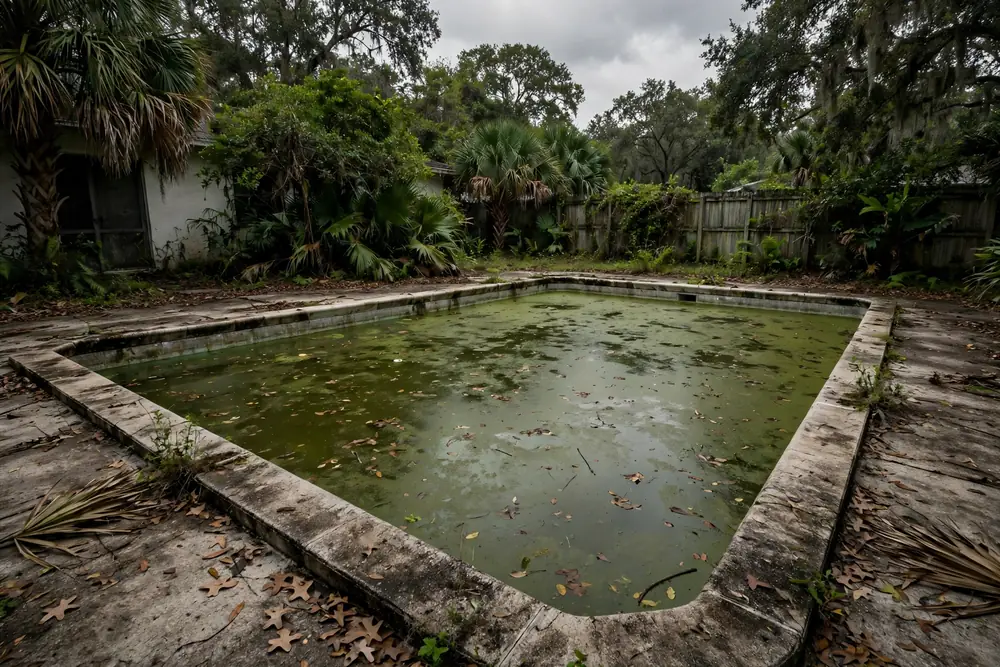
Rainy season, roughly June through September in Southwest Florida, is a four-month chemistry negotiation. Storms dilute sanitizer and stabilizer, wash nutrients off every roof and yard into the water, swing pH and load filters with silt. Pools that stay clear all summer share one trait: their owners treat rain as a scheduled input with a standard response, not as weather to wait out.
The season runs roughly June through October and stacks storms back to back, so the response routine repeats weekly some months. Rhythm, not heroics, is what rainy season rewards.
What a storm actually does to pool water
An inch of rain on an average Cape Coral pool adds hundreds of gallons of water carrying almost no chlorine, no stabilizer and a light acid load, plus whatever the deck and landscaping contribute. Every dissolved number in the pool drops by dilution arithmetic, and organic matter arriving with the runoff starts spending the chlorine that remains. The water rarely shows it on day one; algae publishes the result on day three.
pH moves too, nudged by rain’s acidity and by the aeration of heavy downpours on the surface. Owners who test one number guess; owners who run the full panel after big storms know.
The standard post-storm response
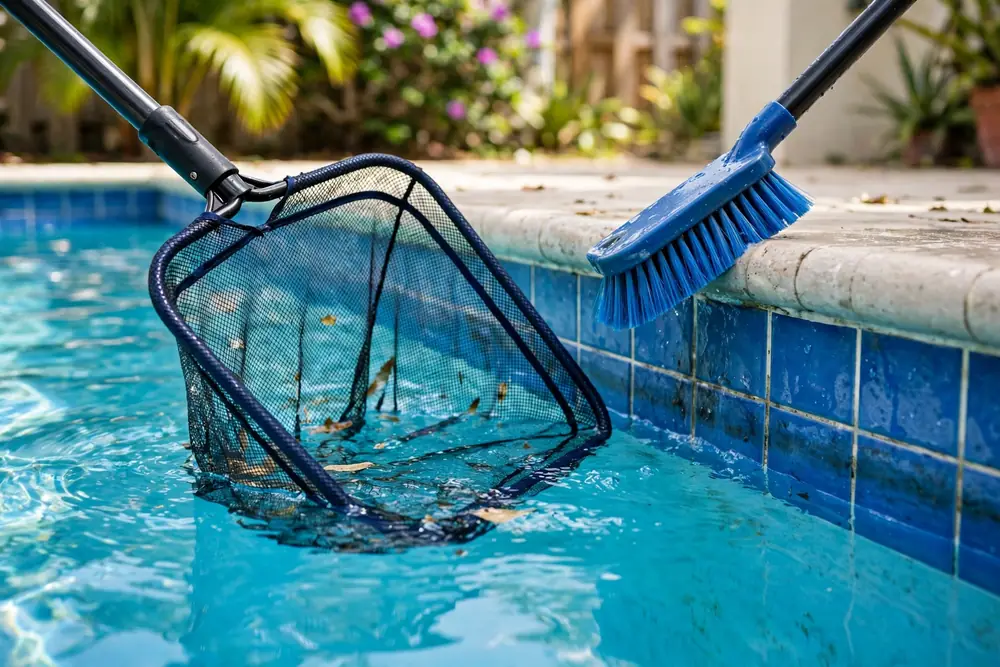
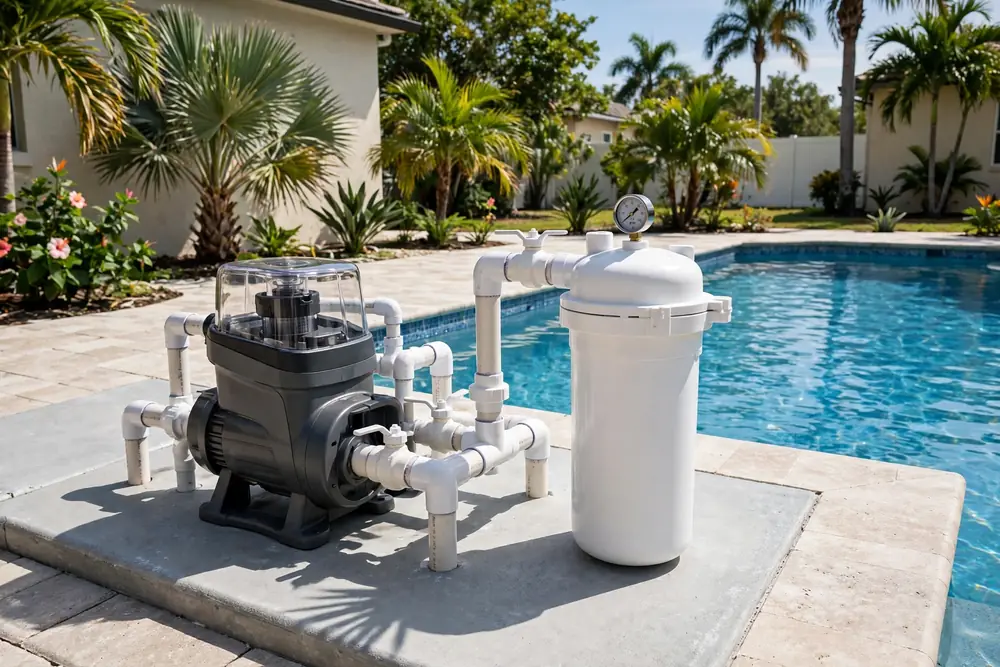
The response is short enough to be a household ritual: safety first around electricity, then skim and empty baskets, brush the walls the runoff fed, run the full test panel, correct in order (alkalinity, pH, sanitizer, stabilizer and salt on salt pools), and let the pump run long while the filter takes the silt load. Filter pressure gets checked that day, because storm silt is exactly what plugs media quietly.
Skipping the brush step is the classic error. Nutrients settle on surfaces where algae anchors; dosing clear-looking water while the walls carry the storm’s cargo treats the wrong compartment.
- Empty skimmer and pump baskets
- Brush walls, steps and waterline
- Test the full panel, correct in order
- Run extended filtration and watch pressure
Algae math in the rainy months
Algae growth follows warmth, light and food, and rainy season maximizes all three between storms. The defense is a chlorine reserve held slightly generous through the season and stabilizer kept in range so the sun does not strip that reserve by noon. Pools that run at the minimum edge of range in May are the green pools of July, and the calendar, not the storm, is usually the cause.
The problem library entry on water turning green after rain walks the equation for a single storm; this guide covers the season-long version of the same fight.
Salt pools in rainy season
Salt systems feel dilution twice: salt itself drops toward the low edge of the operating band, and stabilizer drops with it, so production falls just as demand spikes. After major storms, both numbers deserve a test before the cell gets blamed. Cells also scale faster in the warm months, so the rainy-season check pairs production readings with a plate inspection.
Drainage: the site half of the problem
Some pools fight the same runoff every storm because the lot sends it there. Deck drains aimed at the pool, mulch beds washing across coping and roof valleys dumping beside the cage are site faults wearing chemistry costumes. Redirecting one downspout or regrading one bed edge can outperform a season of extra chemicals, and a service pro will usually name the pattern on the first post-storm visit.
The Two-Day Rule After Heavy Rain
Rain response has a clock. Within the first day, the mechanical work matters most: baskets emptied, overflow drained to mid-tile and debris out before organics stain or sink. Chemistry waits for the second day, once the full dilution has arrived and the water being tested is the water the pool will actually run with.
Owners who reverse the order chase numbers that keep moving and dose twice. Owners who wait a week face algae that took the invitation. Two days, in the right order, is the whole discipline of rainy season response.
- Day one: baskets, debris, water level, equipment check
- Day two: full test, dose, longer filter run
- Log the storm and the response together
- Repeat after the next storm without improvising
Questions and Answers
Should the pump run during a storm?
Running the pump during heavy rain is generally fine and helps circulation, but lightning changes the answer: nobody should be in or handling the pool during electrical storms, and safety guidance always outranks pool guidance.
How much does one storm dilute a pool?
Roughly by the rainfall fraction: an inch of rain on a pool surface replaces a noticeable slice of its chemistry. The test panel after the storm gives the true number for that pool.
Is it normal to add salt after every big storm?
Salt pools often need small top-ups through the rainy season as overflow and dilution carry salt out. Test before adding; the panel display can mislead when the cell is scaled.
Why does the pool turn green two days after rain, not during it?
Algae needs time to multiply past visibility. The storm loads the water on day zero; growth crosses the visible threshold days later, which is why the response window is the first dry day.
Should the pump run during a storm?
Normal operation is fine in ordinary rain. In lightning or flooding conditions, safety rules govern: power off at the breaker and people out of the water, as the safety guide states.
Why does the water cloud even after dosing?
Load and dilution together overwhelm the filter temporarily. The pump runs longer, the filter gets cleaned if pressure says so, and clarity usually follows within days once chemistry holds.
Sources
Last updated: October 23, 2026. Written by the Cape Coral Pool Care editorial team; sourcing and review steps are described on the Editorial Policy page.