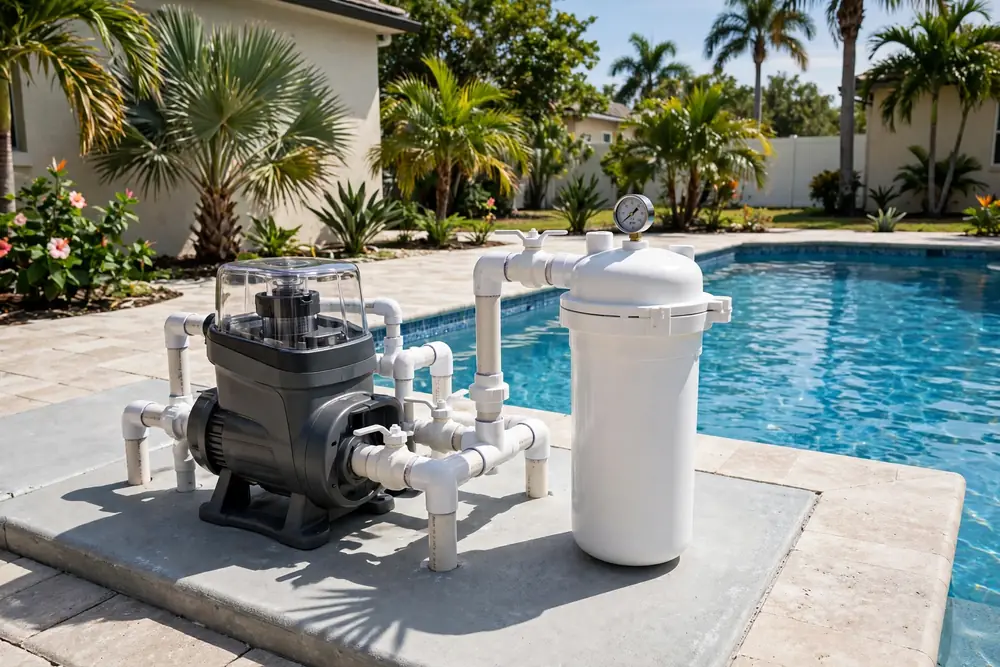
Sand in the pool looks like a cleaning problem and is usually a filter problem. In a sand filter the dirty water enters at the top, passes down through the sand bed and leaves through slotted laterals at the bottom of the tank, the underdrain, on its way back to the pool. Hayward’s ProSeries manual describes exactly that path. Those laterals are the only thing holding the sand in the tank, so a single cracked one lets sand ride the return water straight to the pool floor.
Symptoms
- Fine tan grit gathering in a line or pile near the return jets
- Grit coming back within a day or two of vacuuming
- Sand in the pump basket or the bottom of the skimmer
- A burst of grit right after backwashing and returning to filter
- Gray powder instead of sand on a DE filter
The first job is telling sand from its look-alikes. Mustard algae settles as a yellow-tan dust in shady corners and clouds up when brushed, then drifts. Real filter sand is heavier: it falls straight back down and collects near the returns, where the water enters. Grit blown in by a storm sits wherever the wind dropped it and does not come back once it is vacuumed out.
Common Causes of Sand in Pool Water
| Cause | How likely | What a homeowner can check |
|---|---|---|
| Cracked or broken underdrain lateral in a sand filter | Very common | Note whether the grit appears near the returns and returns after every vacuum |
| Loose or cracked standpipe, or a failed valve gasket at the top of the tank | Common | Watch for a burst of grit right after switching from rinse back to filter |
| Filter sand that is too fine for the filter | Occasional, usually after a recent sand change | Ask what sand was used at the last change and compare it with the grade on the filter label |
| Torn grid or failed manifold in a DE filter | Common on older DE filters | Look for gray powder rather than tan sand on the floor |
| Not filter sand at all: mustard algae or dirt blown in | Common | Brush the pile; algae clouds up and drifts, sand settles straight back down |
Laterals break in predictable ways. Pouring sand into a dry tank shocks them, which is why the Hayward manual says to fill the tank about halfway with water first to cushion the laterals. Age and repeated backwash surges wear them too. Sand grade matters as well: the same manual specifies a filter sand of 0.45 to 0.55 millimeters, also known as No. 20 silica, and sand finer than that can slip through slots that are working perfectly. The repair itself means shutting the system off, opening the tank, removing the sand, replacing the damaged laterals or standpipe and refilling with the correct grade, which is a job for someone who has done it before because the clamp and valve hold the tank under pressure in normal use.
Questions and Answers
Why is there sand in my pool after I backwash?
A small puff right after backwashing can come from skipping the rinse step. Grit that keeps appearing near the returns points to a broken lateral or a standpipe problem inside the filter.
Is it sand or mustard algae?
Brush it. Mustard algae clouds up and drifts away; sand drops straight back to the floor. Algae also tends to sit in shaded corners rather than near the return jets.
Can I keep swimming with sand in the pool?
The sand itself is not harmful, but a filter that is losing its media is not filtering well, and sand in the lines wears the pump and the surface. Plan the repair soon.
Sources
- Hayward ProSeries sand filter owner’s manual: https://hayward.com/media/akeneo_connector/asset_files/I/S/IS210TS_RevA_61ed.pdf