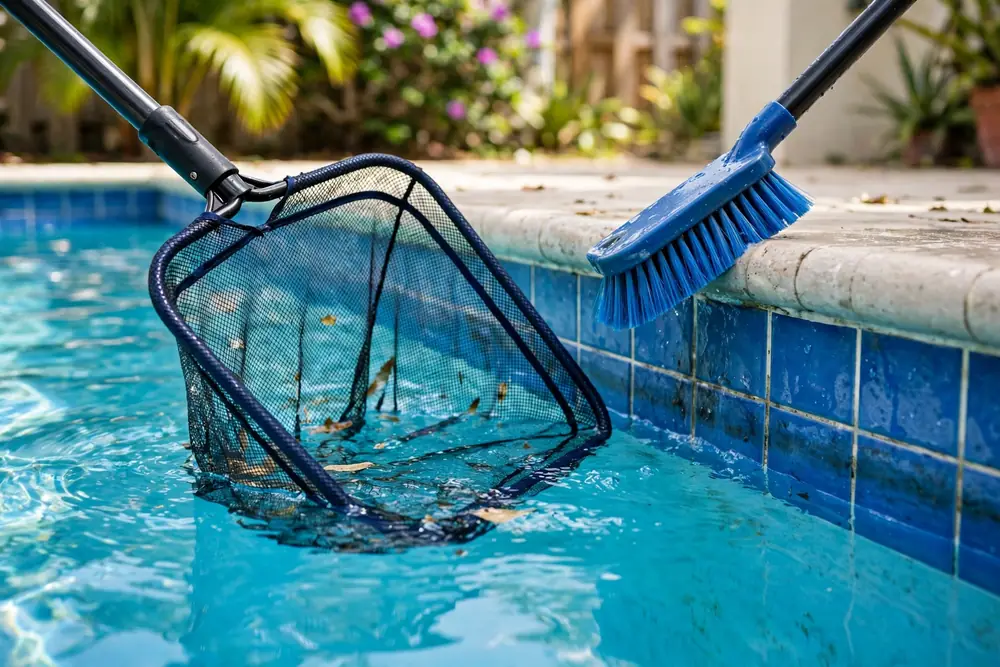
An empty house does not pause its pool. In Southwest Florida heat, an unwatched pool can slide from clear to green in under two weeks, and a small leak or a tripped breaker can run unnoticed for a season. This guide is the away plan: what to arrange before departure, what a caretaker or service route actually watches, and how to return to a pool instead of a project.
Departure and arrival bracket the risky seasons: homes empty through hurricane season need the storm role assigned by name, and homes empty through winter need the cool-spell equipment checks the winter guide describes.
The math of an unwatched pool
Chlorine in a sunlit Florida pool is spent in days, not months. Stabilizer extends the tail but does not stop it, and once sanitizer bottoms out, algae needs only warmth and time, both supplied. Equipment faults compound silently: a pump that trips a breaker on day two leaves thirteen weeks of still water. Every away plan is therefore a monitoring plan; chemistry alone cannot be pre-loaded for a season.
Before departure: the checklist
Leave the pool balanced, the filter cleaned to baseline, the cell inspected on salt systems and the baskets empty, so the first away week starts from the best possible position. Photograph the pad, the water and the gauge readings. Set the timer for a realistic run schedule, confirm who holds a key and the gate code, and make sure the service route or caretaker has the alarm company’s and a local contact’s numbers for the day something looks wrong.
- Balance water and record the readings
- Clean the filter to baseline pressure
- Photograph pool, pad and gauges
- Confirm access, contacts and authority to act
What good away coverage looks like
A weekly visit with the same checklist as an occupied home, plus an away-specific eye: water level trend (the leak early-warning), breaker and timer state, storm response after named weather, and a message to the owner when anything leaves the normal column. The value is not the cleaning; it is the shortening of the time between a fault starting and a human knowing.
Storm season while away
Hurricane preparation for an absent household happens by arrangement, not by flight home: the checklist from the hurricane preparation guide executed by the local contact, power left in the agreed state, and a post-storm inspection visit booked into the plan before the season starts. Owners who arrange this in May sleep better than owners who arrange it during a cone forecast.
Returning home to a pool
Resist the first-day swim until the water proves itself: a full test panel, a look at the equipment log, a filter pressure comparison. A well-kept away pool passes in an hour. A neglected one announces itself honestly too, and the return week is when the green pool recovery pages earn their place in this library.
The Two-Person Rule for Away Homes
Every away-home pool plan has the same single point of failure: one person holding the whole system. The resilient version splits the roles: a service route owns the water and equipment, and a local human, neighbor, house watcher or property manager, owns eyes on the property and the authority to act on alarms, leaks and storm prep.
The split matters most in the bad week. The route reports green water professionally; the local contact notices the running toilet, the soaked yard of a plumbing leak or the enclosure panel flapping in a storm. Pools fail from the property side as often as from the water side.
- Route owns water and equipment
- Local contact owns property eyes and alarm response
- Both hold each other’s phone numbers
- Authority to act is agreed in writing before departure
Questions and Answers
Can a pool be shut down instead of serviced while away?
Draining and mothballing a Florida pool creates structural and surface risks that usually outweigh service cost, and a filled, serviced pool protects the shell. Shutdown is a specialist conversation, not a default.
How often should an away pool be visited?
Weekly is the working standard in Florida heat, matching occupied homes. Longer gaps are where green water and silent faults come from.
What should a caretaker report after storms?
Debris load, power state, water level, cage condition and photographs. The post-storm inspection is the highest-value visit of the season.
Does lowering the pump schedule save money safely?
Modest reductions are common in cooler months with professional judgment. Deep cuts in summer trade small savings for algae risk at exactly the wrong season.
What does the pre-departure visit produce?
A written condition note: chemistry panel, equipment status, water level, known quirks and the next expected service items. That note is the baseline every later report is judged against.
Should the home’s water stay on while away?
Many owners shut the main or fit an automatic shutoff with leak detection, keeping the pool’s auto-fill on its own arrangement. The decision belongs with the property’s plumbing age and the insurer’s requirements, both worth one phone call.
Sources
Last updated: October 23, 2026. Written by the Cape Coral Pool Care editorial team; sourcing and review steps are described on the Editorial Policy page.