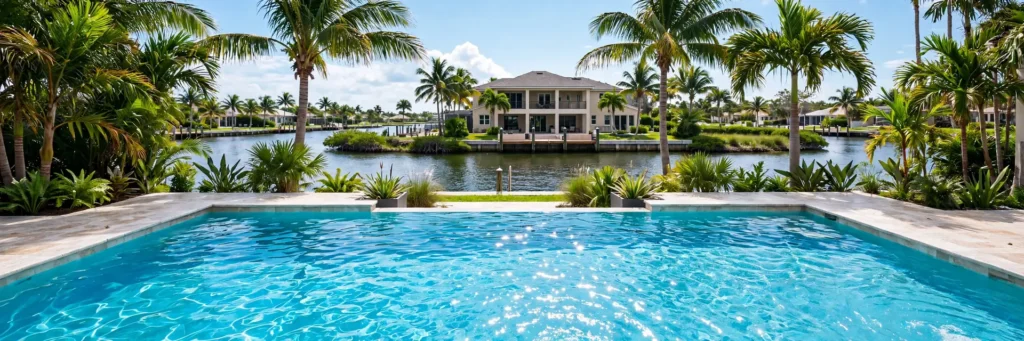
By late summer a Southwest Florida pool can feel more like a bath than a swim. How to cool your swimming pool comes down to a short list of things that actually move the temperature: running water through the air at night, shade, and on some heat pumps a cooling mode built for exactly this.
Warm water is not only uncomfortable. It burns through chlorine faster and gives algae an easier start, so a pool that runs hot all summer needs closer attention to its chemistry as well as its temperature.
Why Florida Pools Run Hot
Sun on the water all day, warm nights that never pull the heat back out, and humid air that slows evaporation all add up. A screen cage blocks some sun but also traps warm, still air over the water. Shallow pools and dark finishes warm faster than deep pools with light plaster.
Ways to Cool a Swimming Pool That Work
- Move water through the air at night. Fountains, deck jets, waterfalls and aerators spray water into cooler night air, where evaporation pulls heat out. Running them overnight and not in the afternoon sun makes the difference.
- Shift the pump schedule. Running circulation through the cooler night hours pairs with the features above and mixes the warm top layer down.
- Add shade. Shade sails, umbrellas and planting on the west side cut the afternoon sun that does the most heating.
- Use a heat pump’s cooling mode, if it has one. Some pool heat pumps are built to heat and cool. Hayward describes its HeatPro heat/cool heat pump as one that heats and cools in-ground pool water. A heat-only unit cannot do this, so check the model before counting on it.
What Does Not Work
Bags of ice melt in minutes against tens of thousands of gallons and barely move the reading. Topping up with a hose adds a little cooler water but also dilutes chemistry, and it is not a cooling plan. Draining part of the pool to refill with cooler water is risky in Florida’s wet ground and rarely worth it.
Warm Water and Chemistry
Hot water uses chlorine faster, so test more often in summer and keep sanitizer and pH in range. The CDC recommends a pH of 7.0 to 7.8 and at least 1 ppm of chlorine in pools, and testing at least twice a day when the pool is in use. A weekly service visit keeps the reserve up between the owner’s own checks.
When to Call a Pool Pro
Call when a heat pump with a cooling mode will not switch modes or shows an error, when a fountain or deck jet stops flowing, or when the water keeps turning cloudy or green through a hot spell despite testing. Those are equipment and chemistry questions a provider can check on site.
Questions and Answers
What is the fastest way to cool a pool?
A heat pump with a cooling mode, where the pool has one. Without it, running fountains or aerators through the night is the most effective option most owners have.
Does a solar cover keep a pool cooler?
A solar cover is made to hold heat in, so leaving it on in summer works against cooling. Take it off while trying to bring the temperature down.
Can any pool heat pump cool the water?
No. Only models built to heat and cool can. The model label or the manual says which kind is on the pad.
Is warm pool water unsafe?
Not by itself, but warm water uses chlorine faster and supports algae, so keep testing and keep chlorine in range through the hottest months.
Sources
- Hayward: 3 things to know about the HeatPro heat/cool heat pump: https://www.hayward.com/blog/post/3-things-to-know-about-the-heatpro%C2%AE-heatcool-heat-pump
- CDC: Home Pool and Hot Tub Water Treatment and Testing: https://www.cdc.gov/healthy-swimming/about/home-pool-and-hot-tub-water-treatment-and-testing.html
Last updated: October 24, 2026. Written by the Cape Coral Pool Connect editorial team; sourcing and review steps are described on the Editorial Policy page.